Understanding a Humerus Fracture
When you have a humerus fracture, it means that your upper arm bone is broken. This type of fracture most often occurs along the middle of the bone or at the end of the bone near the shoulder. It happens most often in elderly adults. Less often, it occurs at the end of the bone near the elbow. This mainly happens in kids or young adults.
The bone may be cracked, or it may be broken into 2 or more pieces. The pieces of bone may be lined up or they may have moved out of place. Sometimes, the bone may break through the skin. Nearby nerves, tissues, and joints also may be damaged. Depending on the severity of the fracture, healing may take several months or longer.
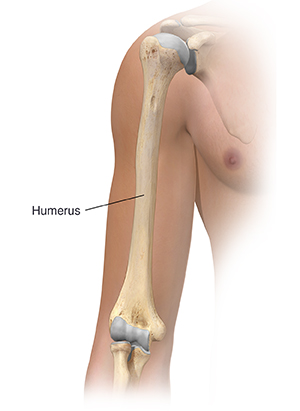
What causes a humerus fracture?
A humerus fracture is most often the result of trauma. This may be from a fall, blow, accident, or sports injury.
Symptoms of a humerus fracture
Symptoms can include pain, swelling, and bruising. If the bone breaks through the skin, bleeding can occur at the site. It may be hard to move and use the shoulder, arm, or elbow as you would normally.
Treating a humerus fracture
Treatment depends on where the bone is broken and how serious the break is. If needed, the bone is put back into place. This may be done with or without surgery. If surgery is needed, the surgeon may use devices such as pins, plates, or screws to hold the bone together. You will then wear a sling, splint, brace, or cast to keep the bone in place and protect it from injury during healing. Other treatments may be also used to help reduce symptoms or regain function. These include:
-
Cold packs. Putting an ice pack on the injured area may help reduce swelling and pain.
-
Pain medicines. Taking prescription or over-the-counter pain medicines may help reduce pain and swelling.
-
Exercises. Doing certain exercises at home or with a physical therapist can help improve strength, flexibility, and range of motion in the shoulder, arm, or elbow.
Possible complications of a humerus fracture
These can include:
-
Poor healing of the bone.
-
Weakness, stiffness, or loss of range of motion in the shoulder, arm, or elbow.
-
Osteoarthritis in the shoulder or elbow.
When to contact your doctor
Contact your doctor right away if you have:
-
A fever of 100.4°F (38°C) or higher, or as directed.
-
Chills.
-
Symptoms that don’t get better with treatment, or that get worse.
-
Numbness, tingling, coldness, or swelling in your arm, hand, or fingers.
-
Fingernails that turn blue or gray in color.
-
A sling, splint, or cast that is damaged or feels too tight or too loose.
-
New symptoms.