A
B
C
D
E
F
G
H
I
J
K
L
M
N
O
P
Q
R
S
T
U
V
W
X
Y
Z
Back to Intro
Click a letter to see a list of conditions beginning with that letter.
Click 'Back to Intro' to return to the beginning of this section.
Understanding Cervical Strain
There are 7 bones (vertebrae) in the neck that are part of the spine. These are called the cervical spine. The neck has several layers of muscles. These are connected with tendons to the cervical spine and other bones. Neck strain is often the result of injury to these muscles and tendons.
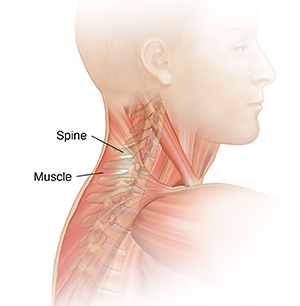
Causes of cervical strain
Different types of stress on the neck can damage muscles and tendons (soft tissues) and cause cervical strain. Cervical tissues can be damaged by:
-
The neck being forced past its normal range of motion, such as in a car accident or sports injury.
-
Constant, low-level stress, such as from poor posture or a poorly set up workspace.
Symptoms of cervical strain
Symptoms may include:
-
Neck pain or stiffness.
-
Pain in the shoulders or upper back.
-
Muscle spasms.
-
Headache, often starting at the base of the neck.
-
Irritability, trouble concentrating, or sleeplessness.
-
Numbness in the arm or hand.
-
Tingling or weakness in the arm.
Treatment for cervical strain
This problem often gets better on its own. Treatments aim to reduce pain and inflammation and increase the range of motion of the neck. Possible treatments include:
-
Changes to your posture or sleep positions. This can help ease muscle tension.
-
Over-the-counter or prescription medicine. These help relieve pain and inflammation.
-
Muscle relaxants, which can help with muscle spasms.
-
Stretching exercises to decrease neck stiffness.
-
Massage to decrease neck stiffness.
-
Cold or heat pack. These help reduce pain and swelling.
Call 911
Call 911 right away if:
-
Your face droops or is numb.
-
You have numbness or weakness, especially in the arms or on one side.
-
Your speech is slurred or you have difficulty speaking.
-
You have blurred vision.
When to contact your doctor
Contact your health care provider right away if:
-
You have a fever of 100.4°F (38°C) or higher, or as directed by your provider.
-
You have chills.
-
Your pain or stiffness gets worse.
-
Your symptoms don’t get better, or they get worse.
-
You feel numbness, tingling, weakness, or shooting pains into the arms or legs.
-
You have new symptoms.
Online Medical Reviewer:
Raymond Turley Jr PA-C
Online Medical Reviewer:
Stacey Wojcik MBA BSN RN
Online Medical Reviewer:
Thomas N Joseph MD
Date Last Reviewed:
3/1/2025
© 2000-2026 The StayWell Company, LLC. All rights reserved. This information is not intended as a substitute for professional medical care. Always follow your healthcare professional's instructions.