A
B
C
D
E
F
G
H
I
J
K
L
M
N
O
P
Q
R
S
T
U
V
W
X
Y
Z
Back to Intro
Click a letter to see a list of conditions beginning with that letter.
Click 'Back to Intro' to return to the beginning of this section.
Stapes Surgery
Stapes surgery can improve conductive hearing. This surgery is done to replace all or part of a damaged (fixated) stapes bone. You will be given general anesthesia during the surgery. Or you may be given local anesthesia with sedation. The surgery takes about 1 to 2 hours.
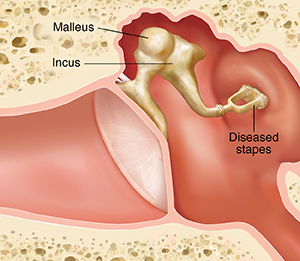
A diseased stapes bone
The stapes bone may become affected by otosclerosis. This is an inherited middle ear disease. The disease creates spongy bone tissue. The tissue grows and hardens around the footplate. The footplate is the part of the stapes that touches the inner ear. Hearing loss may result.
Removing bone
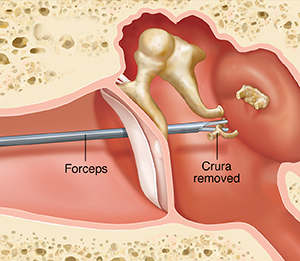
The first step of stapes surgery is to remove the crura. This is the part of the stapes that touches the footplate. Your surgeon reaches the crura by going through the ear canal. They make a cut (incision) around the eardrum. The eardrum is held to one side. Then the crura is removed.
Preparing bone
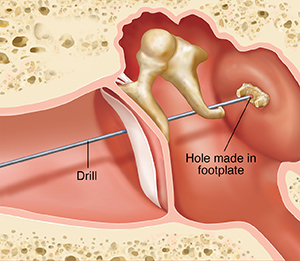
The second step is preparing the diseased footplate for bone replacement. This will let sound vibrations reach the inner ear again. Your surgeon may make a hole in the footplate with a laser or drill. This is called a stapedotomy. Or all of the footplate may be removed and replaced with tissue. This is called a stapedectomy.
Replacing bone
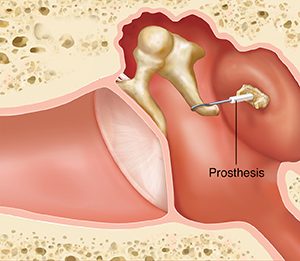
The third step is replacing the crura. A manmade part (prosthesis) is attached to the incus bone. The prosthesis sends sound waves to the inner ear. There are many types of prostheses. They are most often made of metal, plastic, or your own tissue. Some may use more than one of these materials.
Possible complications
As with any surgery, this surgery has risks. You may still have some hearing loss after surgery. In rare cases, the surgery can make hearing loss worse. Or it can make you dizzy or cause injury to the nerve that controls the movement of the face. Talk with your healthcare provider about any complications that this surgery has.
Online Medical Reviewer:
Ashutosh Kacker MD
Online Medical Reviewer:
Marianne Fraser MSN RN
Online Medical Reviewer:
Tara Novick BSN MSN
Date Last Reviewed:
4/1/2024
© 2000-2026 The StayWell Company, LLC. All rights reserved. This information is not intended as a substitute for professional medical care. Always follow your healthcare professional's instructions.