A
B
C
D
E
F
G
H
I
J
K
L
M
N
O
P
Q
R
S
T
U
V
W
X
Y
Z
Back to Intro
Click a letter to see a list of conditions beginning with that letter.
Click 'Back to Intro' to return to the beginning of this section.
Understanding Pterygium
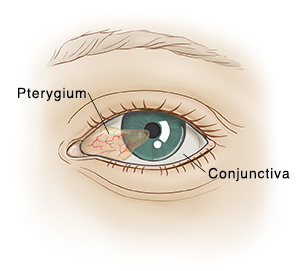
A pterygium is a wedge-shaped growth on your eye. It may be white, pink, or red in color. It's not cancer. But it may cause discomfort and eyesight problems.
Pterygia grow on the conjunctiva. That’s the thin membrane that covers the white part of your eye. They often start growing from the side of your eye near your nose. They may spread across your cornea. The cornea is the clear protective outer layer of the front part of your eye.
A pterygium may grow slowly or quickly. It may even stop growing for a period of time. Some pterygia stay small. These may not cause any problems. Those that grow large enough to spread to the cornea are more likely to cause eye irritation and eyesight problems.
How to say it
tuh-REE-jee-uhm
What causes a pterygium?
Experts don’t know exactly what causes a pterygium, but it's believed that long-term exposure to ultraviolet (UV) rays from the sun may be a major factor. People who spend a lot of time outdoors or live in hot, dry climates are more likely to get a pterygium. So are people who surf. The condition is sometimes called surfer’s eye.
Other possible factors are:
Symptoms of a pterygium
A pterygium may not cause any symptoms, especially if it's small. But if it keeps on growing, you may feel like you have something in your eye. You may also have:
-
Redness and swelling
-
Dryness
-
Itching
-
Burning
-
Blurry vision
These symptoms may look like other health problems. Always see your healthcare provider for a diagnosis.
Treatment for a pterygium
Often, no treatment is needed for a pterygium. From time to time, your healthcare provider will check its size and ask you about any discomfort. If the growth starts to bother you, you may need:
-
Eye drops. These can ease dryness and irritation. You may be able to use over-the-counter artificial tears. Or your healthcare provider may give you prescription eye drops.
-
Other medicines. Your healthcare provider may prescribe ointments and gels, such as topical decongestants, nonsteroidal anti-inflammatory medicines (NSAIDS), or steroids.
-
Surgery. This treatment is often done only if the growth becomes large and affects your eyesight. That’s because pterygia sometimes grow back. When they do, they may be bigger and cause worse symptoms.
When to call your healthcare provider
Call your healthcare provider right away if any of the following occur:
-
Vision gets worse
-
Fever of 100.4°F (38°C) or higher, or as directed by your healthcare provider
-
Symptoms that don’t get better, or get worse
-
New symptoms
Online Medical Reviewer:
Raymond Kent Turley BSN MSN RN
Online Medical Reviewer:
Whitney Seltman MD
Date Last Reviewed:
9/1/2025
© 2000-2026 The StayWell Company, LLC. All rights reserved. This information is not intended as a substitute for professional medical care. Always follow your healthcare professional's instructions.